

Lot n° 109
Estimation :
25000 - 30000
EUR
Result with fees
Result
: 27 300EUR
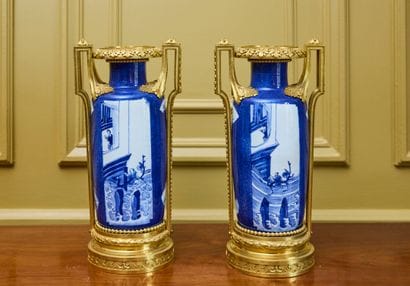
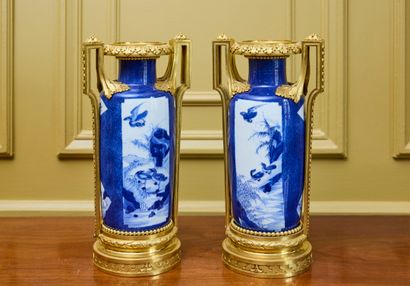
Pair of Kangxi-period blue and white porcelain scroll vases, - Lot 109
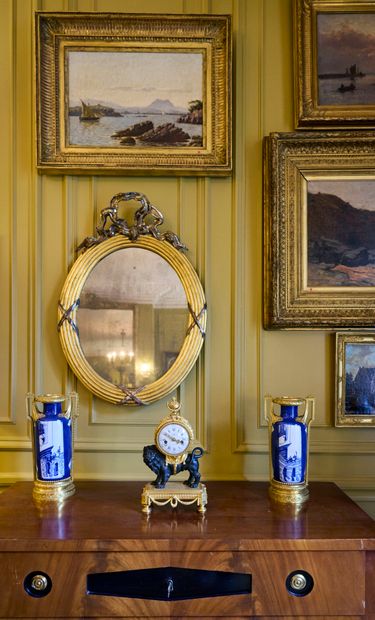
Pair of Kangxi-period blue and white porcelain scroll vases, decorated on one side with animated scenes of characters. The first shows a man riding a dragon, the second a man seated near his window. The opposite sides feature nature scenes with birds. They are adorned with rich, finely chased and gilded bronze mounts. The neck is adorned with an acanthus frieze on an amatized background. The body is flanked by two handles adorned with foliage and a frieze of piastres. It rests on a circular molded base, decorated with a row of pearls, a laurel frieze and posts.
Porcelain vases: China. Kangxi Dynasty (1662-1722).
Bronze mounts: France. Circa 1775.
H_30.5 cm L_14.7 cm
Provenance: Galerie Kugel
The vases presented here date from the Kangxi period. Prior to this period, there was a period of transition between the Ming and Qing dynasties, "a period of development of narrative iconography that became very popular during the Kangxi reign. Fairy tales, tales of popular heroes and beautiful maidens abounded". This type of decoration can be found on a vase in the Metropolitan Museum (fig. 1) and another in the Landesamt für Denkmalpflege, Hesse (fig. 2). The scenes on the latter depict, with striking resemblance, the same mythological scene as on the vases presented here, with figures riding dragons. The blue and white typical of the Kangxi period was renowned for its exceptional quality: "blue and white reached a technical excellence never equalled". It became very fashionable in Europe from the 1680s onwards. This transitional period was marked not only by technical progress, but also by a major evolution in production. After the previous dynasty and the transition period, production increased thanks to the maintenance of imperial kilns and the installation of new kilns for personal consumption and export, the most important of which was at Jingdezhen, in Jiangxi province. In letters published in 1712, Jesuit Father François-Xavier d'Entrecolles asserted that the Chinese had perfected a production chain capable of satisfying the needs of both East and West.
These vases, made in non-imperial kilns, were destined for export to Europe. They most likely arrived in the Netherlands, which then held a monopoly on trade with China, and were then purchased by a Parisian merchant who, in turn, offered them to bronze founders. The latter were renowned throughout Europe for their exceptional craftsmanship, and the ornate vases were considered objects of great luxury, often fetching very high prices at 18th-century auctions.
Fig. 1- White and blue porcelain vase. Early 18th century. Kangxi dynasty. China. Metropolitan Museum of Art, New York, inv. 79.2, 140.
Fig. 2- Porcelain vase. Early 18th century. Kangxi dynasty. China. Hessian State Office for the Preservation of Historic Monuments. Germany. Inv OP 63.
Fig. 3 -Pair of white and blue porcelain vases. Kangxi dynasty. Gilt bronze mounting. Louis XV period. Pair of vases in gilt bronze.
H_30.5 cm L_14.7 cm
Provenance: galerie Kugel
Expert : Stéphane PEPE
Expert: Stéphane PEPE
My orders
Sale information
Sales conditions
Return to catalogue