

Lot n° 18
Estimation :
400 - 600
EUR
Result with fees
Result
: 628EUR
Manuel ORTIZ DE ZARATE (CHILE-FRANCE / 1887–1946) - Lot 18
Manuel ORTIZ DE ZARATE (CHILE-FRANCE / 1887–1946)
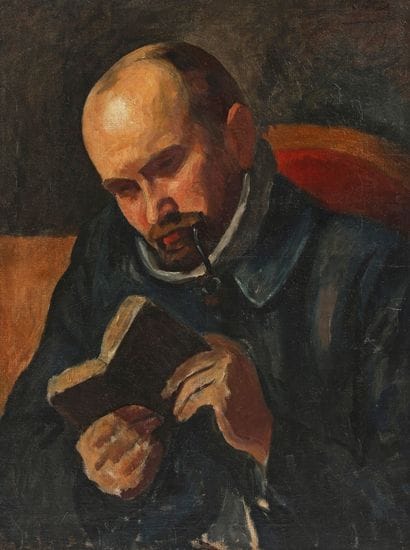
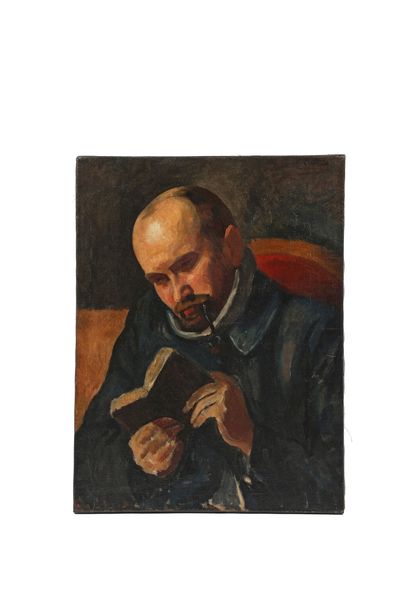
Convalescing Soldier Reading, 1914
Oil on original canvas
Signed and dated indistinctly 'Ortiz 14' (top right)
H_61 cm W_46 cm
This previously unseen work is set against the pivotal moment of the outbreak of World War I, to which it seems to be a direct, if not immediate, echo. The date inscribed—"14"—suggests the painting was executed at the very beginning of the conflict, in a context where depictions of the wounded and convalescents were beginning to enter the artistic field, which was still largely unshaped by the war iconography that would develop later.
The tight, frontal composition isolates a seated male figure, absorbed in reading a book. The tilted head, downcast gaze, and restrained hand gestures contribute to an expressive economy that emphasizes interiority. The presence of a neck brace—an orthopedic device attested to from this period—constitutes a decisive iconographic clue, suggesting a cervical injury resulting from a wound. The loose-fitting coat, rendered in a range of muted blues, plausibly evokes the capotes adopted by the French army beginning in 1914.
The ambiguity of the subject—between a military figure and an intellectual figure—is reinforced by the element of the book, which introduces a reflective and distanced dimension. In this regard, the work can be linked to the imagination of combatant or wounded writers, whose figure is gradually establishing itself in European culture, as exemplified by Guillaume Apollinaire, wounded in 1916, or Louis-Ferdinand Céline, whose experience at the front would later inform his literary work.
Formally, the style is characterized by a vigorous synthesis of volumes, constructed through broad swaths of color and a sketchy, sometimes almost jagged modeling. The visible, energetic brushwork reflects a Post-Impressionist aesthetic marked by the simplification of forms and a certain expressive tension. The palette, dominated by dark tones (browns, blacks, blues), is punctuated by lighter highlights on the face and hands, which concentrate the light and structure the reading of the image. The background, rendered indistinctly, helps to isolate the figure within a mental rather than a descriptive space.
These stylistic characteristics are part of the artistic explorations undertaken by Ortiz de Zárate in the 1910s, particularly in the Parisian context, where the artist was in contact with the avant-garde. The work reflects a personal assimilation of the lessons of Post-Impressionism and a sensitivity to modern issues of representation, where the human figure becomes the site of an inquiry into subjectivity and the individual condition.
Through its tension between historical referentiality and psychological interiority, this painting occupies a unique place at the intersection of genre painting, portraiture, and the representation of trauma. It constitutes a particularly interesting milestone in understanding early artistic responses to the experience of war, viewed not in its spectacular dimension, but in its silent repercussions on the individual.
Expert: Thomas MORIN WILLIAMS
Expert: Thomas MORIN WILLIAMS
My orders
Sale information
Sales conditions
Return to catalogue